

● CPA Letter · Mortgage

CPA Letter for Mortgage

Verified Income for Lenders and Underwriters

A CPA letter for a mortgage is a signed document. A licensed CPA prepares it. It confirms your income and self-employment status for a mortgage lender.
CPA Letter for Mortgage

Starts at $199 · 2-hour express delivery available

Closing the Documentation Gap

Lenders request it when your tax returns or pay stubs don’t tell the full story. You’ll also hear it called a mortgage CPA letter. Other names include a CPA mortgage letter or a CPA verification letter for mortgage.
Self-employed borrowers and business owners need this letter most often. Your deductions can lower your taxable income on paper. Your real earnings can stay strong even then. Lenders see a lower number on your tax return. They assume it reflects your actual cash flow. It usually doesn’t.
At Cortex CPA, Scott Harrison, CPA, prepares mortgage letters for clients across the United States. He formats each one to match your lender’s requirements. That avoids a formatting issue an underwriter can spot fast.

Why this letter exists in the first place

Mortgage underwriting rules grew around a predictable paycheck. That model still works well for W-2 employees. It works less well for other borrowers — you might run a business, work as a 1099 contractor, or earn from multiple clients. A CPA letter gives your underwriter a confirmed read on your real financial picture, without forcing your situation into a format that doesn't fit.

Scott Harrison CPA
Scott Harrison

Lead Verified Income CPA

1,000+ Mortgage Letters Issued

Why Lenders Require It

Standard pay stubs leave a documentation gap

The Documentation Gap

The gap standard pay stubs leave

A W-2 employee has one pay stub and one employer to verify. You don't have that simple paper trail — your income might come from multiple clients or a business you own, and it might shrink due to deductions from your taxable income. A CPA letter closes that gap for your lender.

Who typically asks for this

Loan officers request this letter during underwriting, once your file needs more than a tax transcript. Some lenders ask upfront as standard practice for self-employed applicants; others only request it after underwriting flags a gap.

Why lenders trust a CPA over your own statement

You could write your own income summary, but your lender has no way to verify it. A licensed CPA carries professional accountability through their license — state boards discipline CPAs who misrepresent financial information, which gives your letter real weight.

What It Verifies

A reviewed figure, not a repeated claim

Your CPA reaches these figures by reviewing your actual records — not by repeating the number you provide. That review matters to your underwriter as much as the figures themselves. A letter that only restates your claims carries little weight a documented review carries far more.

This differs from general income verification for a landlord or agency — see the Income Verification CPA Letter guide →. This page covers income verification as your mortgage lender needs it.

A reviewed figure, not a repeated claim
What It Verifies
Annual Income

Your annual income or net business profit

What It Verifies

Employment Status

Your self-employment status and how long you've operated your business

What It Verifies

Ownership

Your percentage of ownership in the business

What It Verifies

Business Type

Your business type and registration details

CPA Letter vs. Other Documentation

How it compares to what you may already have

Document What It Proves Best For Limitation
CPA Letter Income, self-employment status, ownership Self-employed and business-owner borrowers Reflects your CPA's reviewed records, not a guarantee
Bank Statements Account activity and balances Showing cash reserves Doesn't explain your income source
Tax Transcripts Last year's filed return Standard W-2 borrowers Can lag behind your current earnings
Employer Verification Letter Employment status and salary Traditional W-2 employees Doesn't apply if you're self-employed
If you’re self-employed or run your own business, a CPA letter fills the gap other documents leave open — it combines a professional’s review of your records with a signed, accountable statement your underwriter can trust. Bank statements show what came into your account but not where it came from. Tax transcripts may understate your current earnings if your business has grown. An employer verification letter doesn’t apply if you don’t have a traditional employer. A CPA letter addresses all three gaps at once.
Underwriting

How mortgage underwriting evaluates a CPA letter

What underwriters check first

Your underwriter checks three things before reading the actual numbers: does a licensed CPA sign the letter, does the license appear active, and does the format match what their institution typically accepts.

Most common reasons letters get rejected

A missing CPA license number is the top reason. Vague language like "sufficient income" is the second — your underwriter needs an actual dollar figure. Wrong recipient details or a missing loan number is the third.

By Loan Type

Does your loan type change what the letter needs to show?

Yes, in some cases. Different loan types carry different underwriting rules, and your CPA letter should match the one you’re applying for.

CPA letter for a conventional mortgage

Conventional loans follow standard underwriting guidelines. Your CPA letter needs to confirm your income and self-employment status clearly. Most lenders accept a straightforward letter here — they don't usually require extra government-specific language.
Conventional lenders often follow Fannie Mae or Freddie Mac guidelines, which typically average your self-employment income over two years. Your CPA letter should reflect that same averaging approach, keeping it consistent with how your underwriter calculates your qualifying income.

CPA letter for an FHA mortgage

FHA loans carry stricter documentation standards than conventional loans. Your underwriter may want more detail on income consistency over time. Your CPA letter should show a clear income pattern and confirm how long you've run your business.
FHA guidelines often look at a two-year income history, not just one year. Your CPA letter can address that directly — showing whether your income has stayed steady, grown, or declined. A sudden drop without explanation raises questions your underwriter will likely ask about anyway.

CPA letter for a VA mortgage

VA loans serve eligible veterans and service members. VA underwriters often look closely at residual income, not just gross income. Your CPA letter should support that calculation, stating your net income clearly, not just your gross revenue.
Residual income measures what's left after your major expenses. VA underwriters use this number differently than conventional lenders do. Your CPA letter should separate your gross business revenue from your actual take-home income — that distinction matters more here than in most other loan types.

CPA letter for a jumbo mortgage

A jumbo loan exceeds standard conventional loan limits, so lenders carry more direct risk — many jumbo loans don't qualify for resale to Fannie Mae. That extra exposure means heavier scrutiny on your letter, with specific, defensible figures across multiple years rather than one strong year.
Jumbo lenders also examine income consistency closely, and self-employed jumbo applicants face the heaviest review of all. Some jumbo lenders request supporting detail beyond the letter itself — your CPA can reference the documents behind each figure to help your file clear review.

FHA, VA, and jumbo loans generally ask for more detail than conventional loans — FHA wants a longer income history, VA wants a clearer residual-income breakdown, jumbo wants defensible figures across several years. The letter’s core purpose stays the same throughout. Tell us your loan type before we draft your letter.
CPA letter for mortgage refinancing

CPA letter for mortgage refinancing

A refinance works differently than a purchase mortgage — your lender already knows your loan history and wants current proof of your income now. Your refinance CPA letter should focus on your recent financial standing, confirming your income supports your existing or adjusted loan terms.
A cash-out refinance often draws more underwriting scrutiny than a rate-and-term refinance, since you're borrowing against your equity. Your CPA letter should reflect your current income clearly in either case.

Qualification and application timing

Your CPA letter usually enters the process after your initial application, once your file needs more documentation. Some borrowers request it earlier instead of waiting — this works well if you already know your income needs extra verification.
If you're self-employed, your tax deductions can make your qualifying income look lower than it is.

Your Timeline

Where this letter fits in your home-buying timeline

1

Pre-Approval

Lenders often accept estimated figures here. Self-employed buyers benefit most from requesting a letter early, removing one unknown before house hunting.

2

House Hunting

You search and make an offer. Detailed documentation isn't requested yet, but sellers in competitive markets favor prepared buyers.

3

Underwriting

Most CPA letter requests happen here, once your underwriter wants confirmed income instead of estimates. Delays cluster at this stage most.

4

Closing

Outstanding document requests get resolved before this stage. A letter prepared early avoids a last-minute scramble.

Who Can Notarize a CPA Letter
A Common Scenario

How this plays out for a self-employed borrower

A self-employed designer applies for her first mortgage after four years in business with steady clients. Her tax returns tell a different story than her real earnings — years of legitimate deductions lowered her taxable income, and her lender pauses her file to request additional documentation.
She sends two years of returns and her profit and loss statement. Her CPA reviews both, confirms her actual income, years in business, and full ownership, and we format the letter for her lender’s underwriting department. Her underwriter asks one follow-up question about her business structure — we return a revision the same day, and her loan moves forward that week.
If You're Self-Employed
This letter is built for you
Self-employed borrowers request this letter more than any other group. Your business structure shapes what it confirms — sole proprietors, contractors, and LLC owners each document income differently.
Down Payment Funds
Verifying assets and down payment source
Some lenders ask about your down payment source, not just your income, especially when you draw funds from your business. If your lender is questioning your business deductions rather than a withdrawal, see the CPA Expense Ratio Letter guide → instead.
First-Time Buyers

CPA letters for first-time home buyers

First-time buyers face documentation gaps other borrowers avoid — you have no prior home sale for your lender to reference, and newly self-employed buyers face added scrutiny since their income history looks thin by default. A CPA letter frames that shorter history in proper context and can confirm the business income supporting your down payment.

Repeat buyers often hold an existing lender relationship a first-time buyer starts that relationship from zero. A CPA letter helps build it faster.

Get your CPA letter for self-employed today
What's Included

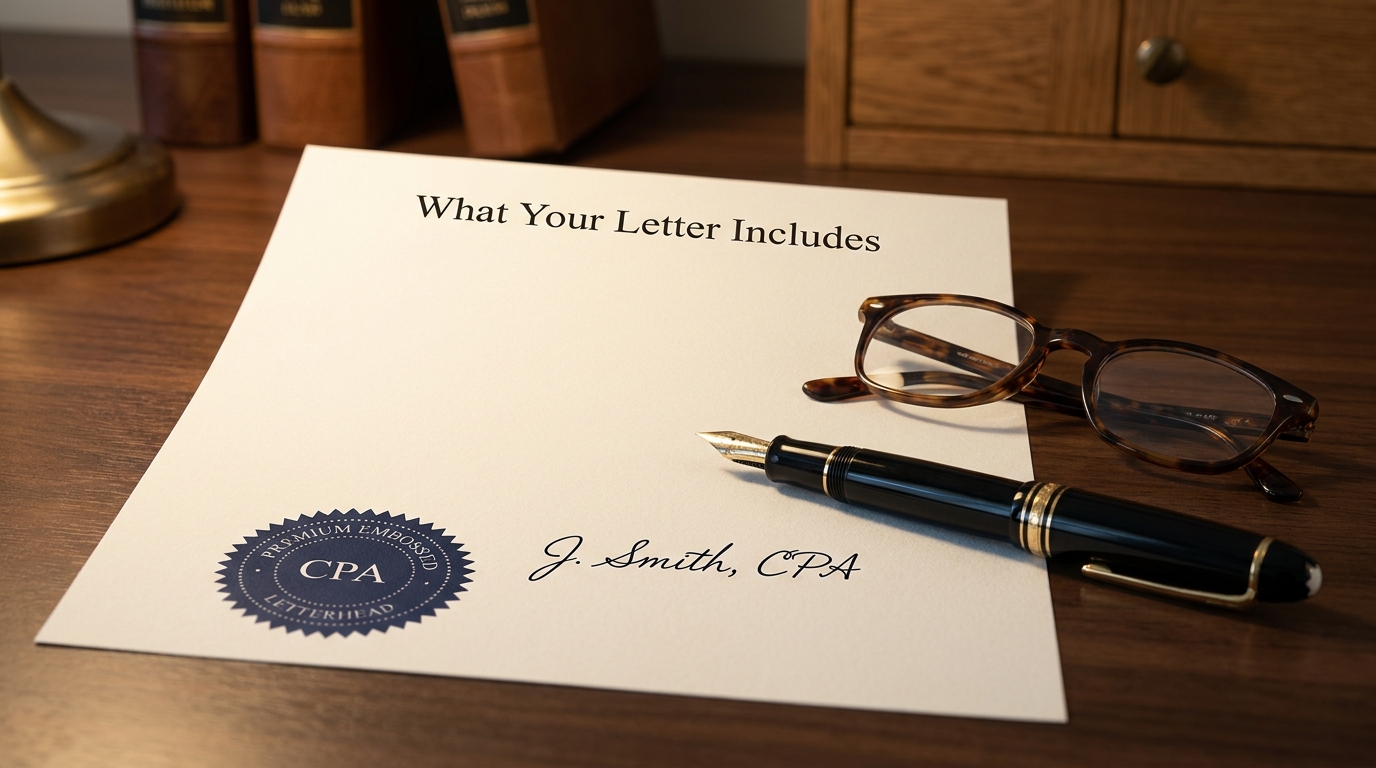
What your CPA letter for mortgage will include

See the full Notarized CPA Letter guide

01
Official letterhead with your CPA’s name and firm
02
A statement of your CPA’s license and credentials
03
The specific income and ownership figures confirmed
04
The time period the letter covers
05
A signed attestation from your CPA

We don’t publish a generic template as a stand-in for an actual letter — your specific lender’s requirements shape the final format. Your CPA letter also has limits worth knowing upfront: it doesn’t guarantee your loan approval, and your underwriter still reviews your full file, not just this one document.

Some lenders require notarization.

The Process

How to get a CPA letter for your mortgage

Tell us your loan type and lender

We need to know whether you're applying for a conventional, FHA, or VA loan, and your lender's specific requirements.

Send your supporting documents

Usually one to two years of tax returns. Self-employed borrowers should also send profit and loss statements.

Scott Harrison, CPA, reviews your records

He checks your actual documents against what you're claiming, then drafts your letter based on that review.

We format your letter for your specific lender

Every lender has slightly different formatting expectations. We match those, so your letter clears underwriting the first time.

You receive your signed letter

It arrives as a digital PDF. We add notarization if your lender requires it.

We revise if your underwriter follows up

Underwriters sometimes ask a follow-up question. We turn most revisions around the same day, so your closing stays on track.

Documents you'll need

Tax returns (1–2 years)
Confirms your income and self-employment history
Profit and loss statements
Shows your current business performance
Business registration documents
Confirms your ownership and business type
Lender's specific request form
Ensures we match their exact format

When to request it

Request your CPA letter as soon as your loan officer mentions it. Waiting until your underwriter formally asks can cost you valuable time — most approval timelines don’t leave much room for a slow response.

Some borrowers request their letter before applying at all. This works well if you already know your income needs extra documentation, and means you’re not scrambling for records during your closing window.

If your underwriter comes back with a question, it usually means one figure needs clarification — send us that feedback as soon as you get it. Both of our packages include unlimited revisions until your loan closes, most turned around the same day.

Common Mistakes

Mistakes that delay mortgage approvals

Waiting for your underwriter to ask.

Requests arrive late in your timeline — order your letter as soon as you expect one.

Sending a generic letter.

Underwriters reject letters that miss their format — your lender’s written request prevents this.

Using an unlicensed preparer.

Bookkeepers and tax preparers can’t sign this letter — only a licensed CPA satisfies your lender.

Leaving out your loan number.

Small omissions send letters back for revision — send us every detail your lender provided.

Assuming one letter covers two lenders.
Each application needs its own version — tell us upfront if you’re applying with several.

Working with your loan officer

Ask two questions before you order anything: whether they need a CPA letter at all — some files clear underwriting without one — and for their format requirements in writing.
Many lenders publish a template or checklist. Forwarding that to us prevents nearly every revision request.

Residential financing and other property types

Most requests involve a primary residence, and your loan type shapes the emphasis more than the property does. Second homes and investment properties bring extra scrutiny, since lenders view them as carrying more risk.
Rental income adds another layer — your lender counts it differently from business income. Tell us the property type when you request your letter.
Frequently Asked Questions

Answers before you ask

What is a CPA letter for a mortgage?
It’s a signed document from a licensed CPA. It confirms your income and self-employment status for your lender.
Standard pay stubs don’t work for self-employed borrowers. A CPA letter fills that documentation gap for your underwriter.
Tell us your loan type and lender. Send your tax returns and business records. We handle the rest.
Your letter needs a licensed CPA’s signature and license details. It also needs specific income figures, not vague language. A missing license number is one of the most common reasons a letter gets rejected.
The core letter stays the same. FHA wants a longer income history, often two years. VA focuses more on residual income than gross revenue.
Jumbo lenders want defensible figures across several years, not just one strong year. The letter’s core structure stays the same.
Yes. Requesting during pre-approval works well in many cases. It removes one step from your later timeline.
Sometimes. Mixed income can confuse underwriters without explanation. A CPA letter presents all your sources as one clear figure.

Not usually. Each lender expects a specific format. We prepare a separate version if you’re applying with more than one lender.

Often, yes. Your lender wants current proof of your income before approving your refinance. This applies to both rate-and-term and cash-out refinances.
It includes your CPA’s letterhead, credentials, and a signed statement. It states your confirmed income and ownership details clearly.
No. It supports your application. Your underwriter still reviews your complete file before deciding.
Our standard package delivers in 2 hours. Our notarized package delivers in 24 hours.
It needs to be a licensed CPA. Most lenders don’t accept letters from unlicensed preparers.
Send us the specific feedback right away. Both of our packages include unlimited revisions until your loan is approved.
Sometimes. First-time buyers often need help documenting down payment sources. Your letter can address that gap directly.
Most lenders expect recent documentation. Letters older than 60 to 90 days often fail review.
Tell us when you submit your request. Your CPA can address the change directly within your letter.
ADDITIONAL RESOURCES

CPA Letter for Self-Employed

CPA Letter for Home Loan

Notarized CPA Letter

CPA Expense Ratio Letter

Back to CPA Letter main page

Get your mortgage CPA letter today

Scott Harrison, CPA, has issued over 1,000 CPA letters since 2021. Get yours started today, with 2-hour express delivery available. Packages start at $199, with notarization available at $349.